Quick answer: Headless CMS enterprise migration becomes essential when legacy monolithic systems restrict release velocity, complicate multisite management, or block omnichannel delivery. Decoupling the architecture to deliver structured content via APIs to any device resolves these bottlenecks. Though requiring investment, phased implementations minimize risk and eliminate the compounding costs of maintaining restrictive architectural constraints.
What a Monolithic CMS Is Actually Costing UK Enterprises
The business case for headless migration begins with an honest accounting of what the current monolithic architecture costs across four dimensions: developer velocity, content operations, security liability, and digital channel coverage.
Developer Velocity
- Monolithic CMS platforms couple front-end templating to back-end content management. Any change to the presentation layer requires access to the CMS codebase, creating a bottleneck where marketing needs and development capacity compete for the same resource
- Plugin and extension ecosystems in platforms such as legacy WordPress or Drupal accumulate technical debt over time. Each update cycle introduces compatibility risks that slow release velocity
- Development teams spend a disproportionate share of sprint capacity on CMS maintenance rather than product development
Content Operations Complexity
- Managing content across multiple regional sites, brand sub-sites, or product areas within a monolithic CMS typically requires either separate installations or complex multisite configurations
- Translating or localising content in a monolithic system often involves duplicating entire page structures rather than managing content variants from a single source
- Editorial workflows are constrained by the permission and publishing models built into the CMS, which rarely match the actual governance structure of the content team
Security Liability
- A monolithic CMS exposes the database and admin interface to the public internet by default. The attack surface includes the CMS core, every installed plugin, and the hosting environment
- Security patches for popular monolithic CMS platforms are frequently released in response to known exploits, meaning unpatched installations are actively vulnerable
- Enterprise organisations in regulated sectors including financial services, healthcare, and legal services carry a specific compliance risk from monolithic CMS security posture that headless architecture structurally eliminates
Digital Channel Coverage
- A monolithic CMS was designed to deliver content to one channel: a website. Content teams managing content for web, mobile app, digital signage, and voice interfaces are working around an architecture that was never designed for the job
- Every additional channel served from a monolithic CMS requires custom development work to extract content from the templating layer
- Omnichannel content delivery via API is an architectural native capability of headless systems, not a custom build requirement
What API-First Architecture Actually Means
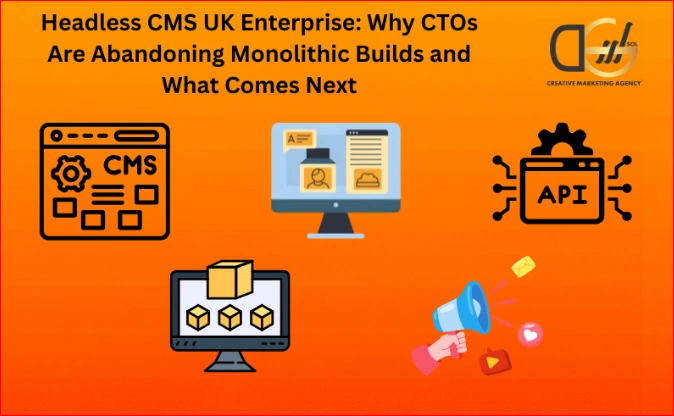
The term API-first is used broadly enough that its specific meaning is often unclear in enterprise planning conversations. In the headless CMS UK enterprise context, API-first means that the content repository is designed from the ground up to deliver structured content via API, with no assumption about how or where that content will be presented.
The Architecture Breakdown
- The content layer stores structured content as data, not as HTML pages. Content types, fields, relationships, and metadata are defined in the content model
- The delivery API, either REST or GraphQL, makes content available to any consuming application that has the correct credentials
- The presentation layer, whether a React application, a Next.js site, a mobile app, or a digital signage system, fetches content from the API and renders it according to its own design system
- Multiple front-ends can consume the same content layer simultaneously, each applying its own presentation logic
- The content and the presentation can be updated, redeployed, or replaced entirely independently of each other
REST vs GraphQL for Enterprise
- REST APIs deliver predefined responses from predefined endpoints. They are simpler to implement, better supported by legacy enterprise tooling, and generally easier to cache
- GraphQL APIs allow the consuming application to specify exactly which fields it needs in each request, reducing data transfer volume and eliminating the over-fetching problem common in REST implementations at scale
- Enterprise decisions between REST and GraphQL are typically driven by existing developer tooling, team expertise, and the complexity of the content model rather than by a universal recommendation
The way AI-powered search engines evaluate and index content from API-first architectures has important implications for enterprise search visibility. Because of this, understanding how to make AI visibility actually improve SEO rankings is increasingly relevant to headless architecture planning decisions that affect how content is structured and delivered.
Monolithic vs Headless CMS: The Enterprise Decision Framework
The table below compares monolithic and headless CMS UK enterprise architectures across the dimensions most relevant to UK enterprise CTOs and digital directors making platform decisions in 2026.
Here is the data formatted into a clear comparison table:
| Dimension | Monolithic CMS | Headless CMS (API-First) |
| Content delivery | HTML pages rendered by CMS templating | Structured data via REST or GraphQL API |
| Front-end freedom | Constrained by CMS template system | Any framework: React, Vue, Next.js, native app |
| Channel coverage | Web by design, others by workaround | Web, mobile, signage, voice, all natively |
| Security posture | CMS admin and database exposed to web | Content API only; no public database exposure |
| Developer velocity | Slowed by CMS update cycles and plugins | Front and back-end teams work independently |
| Content reuse | Page-level, duplicated per channel | Component-level, single source, all channels |
| Multisite management | Separate installs or complex multisite | Single content repository, multiple front-ends |
| Migration complexity | Low initial, high accumulated over time | Higher initial, lower long-term total cost |
The MACH Architecture Principle and Why It Matters for UK Enterprises
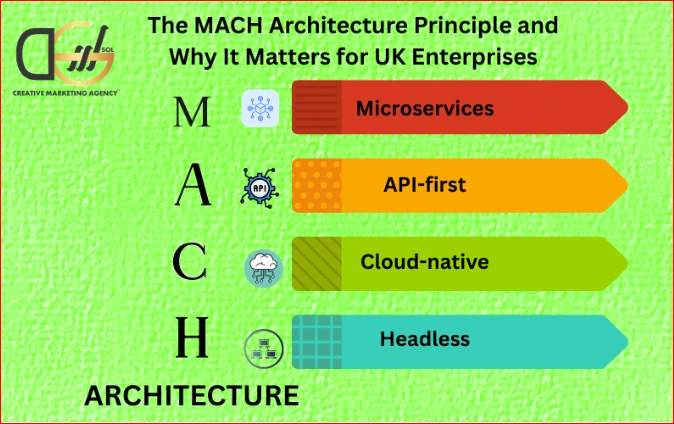
MACH stands for Microservices, API-first, Cloud-native, and Headless. It describes the composable architecture approach that an increasing number of headless CMS enterprise technology teams are adopting as the alternative to monolithic platform dependency.
The MACH approach replaces a single monolithic platform with a composed stack of best-of-breed services, each connected via APIs and each independently updatable, scalable, and replaceable.
- Microservices: business capabilities are delivered as independent services, such as a separate commerce engine, a separate search service, and a separate content delivery system
- API-first: every service exposes its functionality through documented APIs, making integration between services a standardised process rather than a custom build project
- Cloud-native: services are designed to run in cloud environments, scaling automatically in response to demand without requiring manual infrastructure management
- Headless: the front-end presentation layer is fully decoupled from the back-end services, consuming everything via API
UK enterprises in retail, media, financial services, and professional services are adopting MACH as the architectural framework for digital transformation programs because it eliminates the platform dependency risk of monolithic builds while preserving the flexibility to replace individual components as the market evolves.
The intersection of headless architecture and modern algorithms indexing distributed content clearly illustrates how Generative AI SEO is changing the Future of Search Rankings. This evolution directly affects enterprises, especially those that rely on their structured content being reliably found, cited, and recommended by AI search systems.
Migration Strategy: How UK Enterprises Move to Headless Without Breaking Production
The most common reason UK enterprise technology teams delay headless CMS migration is the perceived risk of disrupting a production system the business depends on. A well-structured migration program manages this risk through phased implementation rather than a single cutover event.
Phase One: Content Model Design
- Before any technical migration begins, the content model must be designed. This defines the content types, their fields, their relationships, and the governance rules that will govern how content is created and managed in the new system
- Content model design is the highest-leverage decision in the migration. A poorly designed content model creates structural debt in the new system that is expensive to correct after migration
- The content model should be designed by a team that includes both editorial stakeholders who understand how content is created and technical architects who understand how it will be consumed
Phase Two: Pilot with a Non-Critical Front-End
- The first implementation should be a non-critical front-end, such as a blog, a campaign microsite, or a documentation section, that can be rebuilt on the headless architecture without risk to the primary production system
- The pilot validates the content model, tests API integration patterns, identifies gaps in the content governance design, and provides a proof of concept for internal stakeholders who need to see the architecture working before approving full migration
- The pilot phase typically runs four to six weeks and produces both a working front-end and a set of validated architecture decisions for the full migration program
Phase Three: Core Content Migration
- Primary content types are migrated in priority order, with the highest-traffic and highest-business-value sections moved first
- The legacy system runs in parallel during core content migration, providing a rollback option if specific content types reveal unexpected migration complexity
- URL structure, redirect mapping, and SEO signal preservation are critical considerations during this phase. Every redirected URL must be mapped before content is decommissioned from the legacy system
Phase Four: Legacy Decommission
- The legacy system is decommissioned only after the new architecture has demonstrated stability under production load across all migrated content types
- Editorial teams require training and workflow documentation before legacy system access is removed
- A final content audit should verify that every piece of content, every URL, and every internal link has been correctly migrated before the legacy system is taken offline
SEO Implications of Headless Architecture
One of the most significant concerns UK enterprise digital teams raise about headless migration is the potential impact on SEO performance. The concern is legitimate but manageable when the architecture and migration are planned correctly.
- JavaScript-rendered front-ends, the most common presentation layer choice for headless implementations, require careful SEO planning. Google’s crawler can render JavaScript but does so more slowly than it processes server-rendered HTML
- Server-side rendering or static site generation at build time are the recommended approaches for content that carries SEO value. Next.js, Nuxt, and Gatsby are the most widely used frameworks for this purpose in UK enterprise headless implementations
- Structured data and schema markup must be implemented in the new front-end, not assumed to carry over from the legacy system. Schema that existed in the old CMS is not automatically present in the new architecture
- URL structure preservation is the highest-priority SEO task during migration. Every URL that carries ranking value must either be preserved exactly or redirected with a permanent redirect to its equivalent in the new architecture
- Canonical tags, hreflang attributes for multilingual content, and XML sitemap generation must all be implemented explicitly in the new front-end rather than relying on CMS defaults
Building Headless Architecture With DGSOL UK
Headless CMS migration for UK enterprises requires a development partner who understands both the technical architecture of API-first builds and the business constraints of migrating a production system without operational disruption. These are different disciplines, and most agencies are strong in one but not both.
DGSOL builds headless CMS implementations for UK enterprises using platforms including Contentful, Sanity, and Hygraph, paired with Next.js and React front-ends optimized for both performance and search visibility. The migration methodology covers content model design, phased implementation, SEO signal preservation, and editorial team onboarding.
For UK CTOs and digital directors who have identified the architectural ceiling of their current monolithic CMS and need a development partner with the technical depth to plan and execute a migration program without production risk, DGSOL UK provides the capability and methodology to ensure a successful transition.
Conclusion
With headless CMS UK enterprise adoption moving past the early-adopter phase, technology leaders are now focusing on the critical business case for migration: the mounting costs and friction of legacy monolithic systems far outweigh the investment required to modernize. Because the architectural, security, and omnichannel advantages of these platforms are firmly validated across industries, the question is no longer if, but when and how to transition. DGSOL provides the technical precision and project governance required to seamlessly guide production-critical systems through this essential modernization.
Contact DGSOL UK today to scope your headless CMS migration and build the API-first architecture your enterprise needs to scale without limits.
FAQs
What is a headless CMS and how is it different from WordPress or Drupal?
A headless CMS stores content as structured data and delivers it via API, separating it entirely from the front-end design. Unlike traditional WordPress or Drupal, which tightly couple content with HTML templates, a headless system gives developers total freedom over the presentation layer.
Is headless CMS migration right for every UK enterprise?
No, it’s best suited for enterprises managing content across multiple channels, facing slow development speeds, or needing omnichannel delivery. Businesses with a single, simple website might find the added architectural complexity of a headless setup unnecessary.
How long does a headless CMS migration take for a UK enterprise?
A full migration generally takes 6 to 12 months, depending on content volume, model complexity, and necessary third-party integrations. However, a smaller pilot implementation to test a non-critical front-end can often be completed in just 4 to 6 weeks.
Does headless migration affect SEO performance?
It can impact SEO based on implementation; server-side rendering (like Next.js) often improves it, while purely client-side rendering poses crawlability risks. Strict execution of URL redirects and structured data mapping is vital during migration to prevent ranking drops.
What is the MACH architecture principle and why is it relevant to UK enterprises?
MACH (Microservices, API-first, Cloud-native, and Headless) connects independent digital services via APIs, allowing parts to be swapped without rebuilding everything. UK enterprises adopt it to escape vendor lock-in and shed technical debt caused by rigid monolithic platforms.
How does DGSOL UK approach headless CMS implementation for UK enterprises?
DGSOL uses platforms like Contentful and Sanity paired with high-performance Next.js front-ends to optimize speed and SEO. Their phased methodology ensures zero production disruption while tailoring content modeling and editorial onboarding to each client’s specific goals.