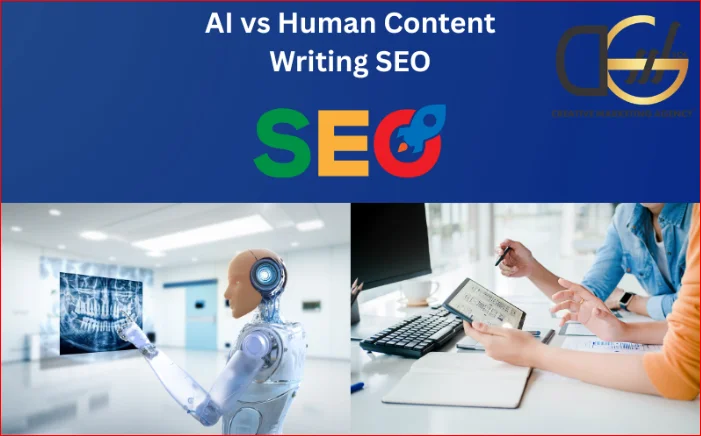
The answer is more interesting than most people expect. And in 2026, the data will finally give us a clear picture.
This blog breaks down the real performance differences in AI vs human content writing for SEO, covers what Google actually rewards, and explains why the smartest UK businesses are no longer choosing one side. They are combining both.
What Is AI Content Writing and How Does It Work?
AI content writing refers to text produced by large language models such as ChatGPT, Google Gemini, or Claude. These tools process vast amounts of training data and generate written responses based on prompts.
An AI can produce a 1,500-word blog post in under a minute. It follows grammatical rules, uses keywords naturally, and can structure an article with headings and paragraphs. For businesses trying to publish content at scale, this speed is genuinely useful.
However, AI writes by predicting the next most likely word or sentence based on patterns in its training data. It does not have lived experience, professional qualifications, or the ability to verify real-world facts without additional tools. This distinction matters greatly for SEO in 2026.
What Is Human Content Writing and Why Does It Still Matter?
A real person creates human content writing: a trained copywriter, subject-matter expert, or journalist who draws on their own knowledge, experience, and research.
Human writers can do things AI currently cannot. They notice emotional nuance in a topic. They interview sources. They recall a client conversation that changed how they thought about a problem. They write with genuine authority because they have actually worked in the field they are covering.
For Google, this difference shows up in a very specific set of quality signals that we will cover shortly.
AI vs Human Content Writing SEO: The 2026 Data
The debate about human vs. AI content writing SEO has moved from opinion to evidence. Here is what the latest research shows.
A Semrush study published in April 2026, analyzing 42,000 blog posts across 20,000 keywords, found that human content holds the number one position on Google 80% of the time. Pure AI-generated content, published without editorial improvement, consistently filled the lower positions.
A separate 16-month study tracking 4,200 articles across 140 domains found that unedited AI-generated content ranked, on average, 23% lower than human-written articles targeting the same primary keywords.
Despite AI being everywhere, 83% of pages ranking at the top of Google’s search results still rely heavily on human expertise, original insight, and genuine editorial oversight. These numbers are not surprising once you understand what Google is actually measuring.
How Google Evaluates Content in 2026

Google does not technically care whether a human or a machine wrote your content. What it cares about is whether the content is helpful, trustworthy, accurate, and written for real people rather than search engine algorithms.
This evaluation is guided by the E-E-A-T framework: Experience, Expertise, Authoritativeness, and Trustworthiness. If you want to understand how to Build Trust and Rank Higher, you should know Google E-E-A-T.
Here is what each element means in practice:
Experience refers to first-hand knowledge. Has the author actually done what they are writing about? Have they used the product, visited the location, or worked in the industry?
Expertise is about demonstrated knowledge. Can the author clearly explain why something works, not just that it does?
Authoritativeness is what others say about you. Are respected websites linking to your content? Is your brand mentioned in credible publications?
Trustworthiness is about accuracy, transparency, and reliability. Does your site have clear author information, updated content, and no misleading claims?
AI-generated content often struggles with Experience because it has none. It can mimic expertise, but it cannot demonstrate lived knowledge. This is why raw AI output, even when technically accurate, tends to feel flat to both readers and search engines.
Key Differences: AI vs Human Content for SEO
The table below breaks down the core differences between AI-generated content and human-written content from an SEO standpoint.
Here is the data organized into a proper comparison table:
| Factor | AI-Generated Content | Human-Written Content |
| Speed of Production | Very fast (can produce articles within minutes) | Slower process (may take hours per article) |
| Keyword Optimisation | Strong optimization out of the box | Requires deliberate keyword planning and SEO strategy |
| E-E-A-T Signals | Weak without human editing or expertise | Naturally stronger when written by experienced experts |
| Search Intent Accuracy | Often surface-level and generic | Better understanding of reader intent and needs |
| Originality | Lower originality due to pattern-based generation | Higher originality with personal insight and unique perspectives |
| Engagement & Dwell Time | Often, lower engagement rates | Generally, higher engagement and longer dwell time |
| Factual Accuracy | Can be unreliable without fact-checking | More reliable when backed by proper research |
| Long-Term Ranking Stability | Rankings can be volatile | More stable and consistent over time |
The pattern is clear. AI has real strengths in production speed and initial structure. Humans provide the quality signals that determine whether content actually ranks and stays ranked.
Why Does Human Content Rank Higher in Competitive Searches?
This is a question many UK marketers search for, and the answer connects directly to how Google measures user behavior.
When someone clicks on a page and leaves immediately, that is a negative signal. When they scroll deep, read to the end, or click through to another page, those are positive signals. Human-written content, particularly on complex or sensitive topics, consistently drives better engagement.
Human writers naturally address the “why” behind a topic. They include edge cases, practical examples, and relatable context. AI content often produces what one content strategist described as a “wall of text” covering known facts generically. It ranks well for traffic early on, but does not build trust or retain readers.
Sites that used AI as a content factory, publishing hundreds of lightly edited pages, saw their rankings drop. Sites that used AI responsibly, as a drafting tool with heavy human editing, were largely unaffected.
What Competitors Are Missing: The AI Content Nuance
Most competitors covering AI vs human content writing SEO focus on speed versus quality. That is the obvious comparison. What they miss is the role of content intent depth.
AI tools are very good at writing in a broad sense. They cover the obvious angles on any topic and check most of the on-page SEO boxes. What they miss is the specific question a reader actually has.
For example, a human writer working with a UK digital marketing agency understands that a small business owner in Manchester has different concerns about SEO budgets than a startup founder in London. They write to that specific reader. AI writes to a general audience.
In 2026, with Google prioritizing content that satisfies specific user intent rather than general keyword matching, this difference is increasingly visible in rankings.
Another thing competitors often skip is the impact of AI content on brand trust. Readers in the UK are becoming more sensitive to robotic-sounding content. If your blog feels like a machine produced it, it affects how prospects perceive your brand, even if they cannot identify exactly why.
The Hybrid Content Strategy: What Actually Works in 2026
The winning approach is neither purely AI nor purely human. It is a hybrid content strategy where each handles what it does best.
Here is how the most effective UK content teams are working in 2026:
| Stage | AI Role | Human Role |
| Keyword and topic research | AI tools surface data and gaps | Humans select based on business goals |
| Content brief and outline | AI generates initial structure | Human refines for intent depth |
| First draft | AI produces a fast baseline | Human rewrites for voice and experience |
| Fact-checking and enrichment | AI assists with sourcing | Human verifies and adds unique insight |
| Final editing and publishing | AI tools check grammar and readability | Humans make all final editorial decisions |
Understanding what are content pillars and their importance is key to making any hybrid strategy work, as human writers define the core pillar topics. At the same time, AI tools produce supporting cluster content at scale. A skilled editor can then refine an AI draft in significant time and cost savings. The quality, when done right, matches or exceeds all-human production because writers focus their energy on what matters most: insight and accuracy.
When Should UK Businesses Use Human Writers Over AI?
There are content types where human expertise is not just better but essential.
YMYL content (Your Money, Your Life) covers topics like finance, health, legal services, and medical advice. Google holds these pages to the highest E-E-A-T standards. AI lacks the qualifications, the verified accuracy, and the professional accountability that these topics demand. Using raw AI output for YMYL content is one of the fastest ways to damage your domain authority.
Thought leadership and opinion pieces require a genuine perspective. AI can produce balanced, neutral text, but it cannot have an opinion grounded in professional experience. If your content strategy relies on positioning your brand as an authority, you need human voices.
Local and community-focused content for UK audiences benefits enormously from real local knowledge. A writer who understands the Manchester business community, the nuances of UK consumer law, or the specific challenges facing SMEs in a particular region will produce content that connects in ways AI simply cannot.
How DGSOL UK Helps Businesses Get Content Right for SEO
If you are a UK business trying to get your SEO content strategy working in 2026, this is where DGSOL UK brings real, practical value.
We provide a full range of SEO services built around the quality signals that Google rewards. This includes thorough keyword and competitor research to identify high-value search terms your ideal audience is actually using. The team conducts an in-depth analysis of your industry and competitors to identify keyword opportunities that align with genuine user intent.
SEO content writing at our platform means producing high-quality, engaging, and optimized content: blog posts, website copy, and landing pages that serve readers first and search engines second. The approach combines keyword integration with strong editorial standards so content performs both technically and in terms of reader engagement.
On-page SEO services cover everything from meta title and description optimization to heading structure, internal linking, and content formatting. We also offer technical SEO support, off-page SEO, and local SEO services for businesses targeting UK regional audiences.
The underlying philosophy at DGSOL UK matches exactly what the 2026 data supports: that content which earns trust, demonstrates expertise, and genuinely helps the reader is what wins long-term ranking stability. Whether your business needs a fully managed content strategy or support in optimising what you already have, we tailor our approach to your specific goals and budget.
Conclusion
The question of AI vs human content writing SEO does not have a simple answer in 2026. What the research does confirm is this: purely AI-generated content published without expert editorial oversight consistently underperforms. Human-written content, built on real expertise and genuine insight, still dominates the top positions in competitive searches.
The smartest approach for UK businesses is a hybrid strategy. Use AI for speed and structure. Use human writers for depth, authority, and trust. And make sure every piece of content you publish genuinely helps the reader, because that is exactly what Google is measuring.
Ready to build an SEO content strategy that actually ranks? Contact DGSOL UK today for a free consultation and let our team show you how to get real results.
FAQs
Does Google penalize AI-written content?
Google does not automatically penalize AI-generated content. It penalizes low-quality, unhelpful, or manipulative content regardless of how it was produced. AI content that is edited, fact-checked, and enriched with real human expertise can rank well.
Can AI replace human content writers for SEO?
No, not fully. AI can produce fast first drafts, assist with keyword structuring, and help scale content production. However, it cannot replicate first-hand experience, professional expertise, emotional connection with readers, or the editorial judgment needed to create content that builds genuine brand authority.
Which performs better in SEO, AI, or human content?
Based on multiple large-scale studies in 2025 and 2026, human-written content consistently ranks higher in competitive search positions. A Semrush study of 42,000 blog posts found human content holds the top Google position 80% of the time. However, a hybrid approach combining AI efficiency with human expertise performs best overall.
How does E-E-A-T affect AI-generated content?
E-E-A-T (Experience, Expertise, Authoritativeness, Trustworthiness) is central to how Google evaluates content quality. AI content typically lacks the Experience and Expertise signals that come from a real person with professional knowledge in the subject area. Without strong E-E-A-T signals, AI content is less likely to rank well, especially for competitive or sensitive topics.
Is a hybrid content strategy better for SEO in 2026?
Yes, consistently. The hybrid model, using AI for initial drafts and structure, combined with expert human editing, enrichment, and fact-checking, produces content that is both scalable and high-quality.
How many times should I use AI tools in my SEO content workflow?
AI is most effective at the research, outlining, and drafting stages of content production. Human review and editing should follow every AI-generated draft before publication. The key is never publishing raw AI content without editorial improvement. Using AI to assist does not lower content quality as long as humans retain final control over accuracy, tone, and value.
Can DGSOL UK help my business create SEO content that ranks in 2026?
Yes. It is a UK-based creative marketing agency that offers a comprehensive range of SEO and content services, including keyword research, SEO content writing, on-page optimisation, technical SEO, and local SEO. Whether you need a full content strategy or help improving existing pages, we build tailored plans around your business goals and budget, with a focus on delivering real, measurable organic growth.