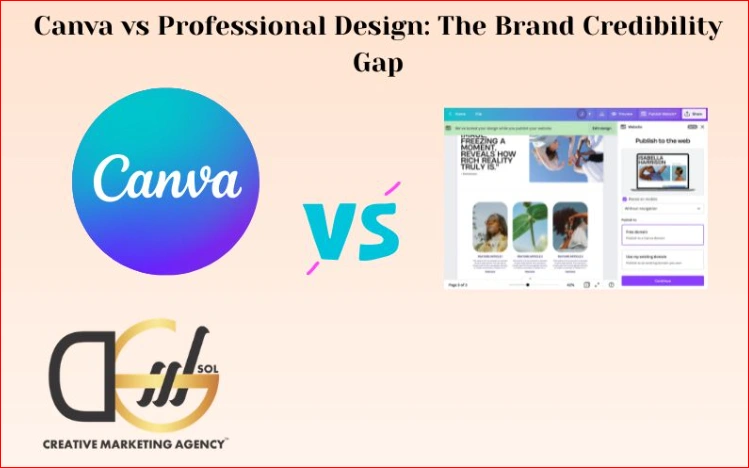
Here is what this comes down to for most businesses:
- Templates are built for speed, not for strategy
- Shared design assets mean shared visual identity with your competitors
- Brand inconsistency signals a lack of investment to potential customers
- Professional design solves problems templates were never built to address
Quick answer: Canva vs professional design is not about which tool is better. It is about what you are trying to achieve. Templates handle quick content. Professional design builds brand equity, credibility, and a visual identity that no competitor can replicate by changing a color palette.
The Real Cost of Template Design
Canva is a capable tool. It is fast, accessible, and genuinely useful for producing quick social posts, internal documents, or short-run promotional content. Nobody is arguing otherwise.
The problem begins when businesses treat Canva as their design strategy rather than a production shortcut. At that point, they are not building a brand. They are borrowing one.
The Template Overlap Problem
Every template in Canva has been used before. Most have been used thousands of times. When you select a layout, adjust the brand colours, and swap in your logo, the structural bones of that design still belong to the template. The proportions, the font pairing, the spatial rhythm, and the visual hierarchy all remain identical to the original and to every other business that started from the same file.
The result is what designers call visual sameness. Your brochure looks like a competitor’s brochure. Your social post sits in the same design language as an unrelated business three industries away. Your shopfront window graphic could belong to anyone.
What Brand Inconsistency Actually Signals
Most customers cannot articulate why one brand feels trustworthy and another does not. They do not consciously notice that the font weight changes between the leaflet and the website, or that the logo appears slightly different across printed materials. But they register the inconsistency as a feeling, and that feeling translates directly into how much they trust the business.
Canva does not enforce design consistency across materials. Each template is a standalone starting point. Without a tightly managed brand system sitting behind every output, materials drift over time. That drift is visible and undermines brand credibility in ways that are difficult to recover from without a full reset.
The Hidden Time and Opportunity Cost of “DIY” Design
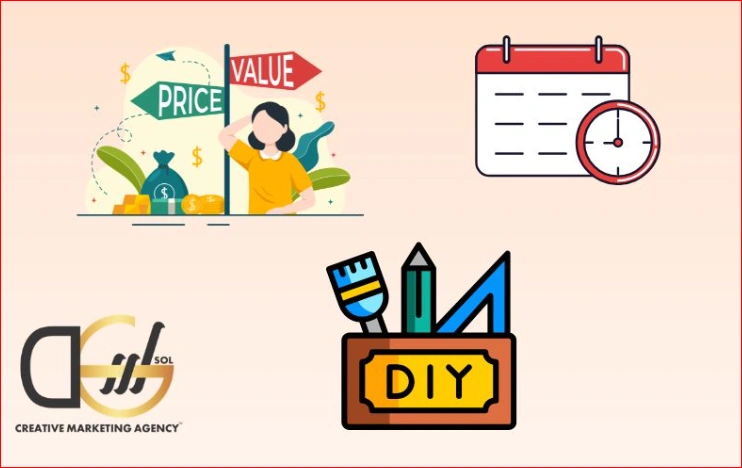
When business owners weigh Canva against professional design, they usually only compare the financial cost: a monthly software subscription versus an agency fee. What this calculation misses is the single most expensive resource in any business—the founder’s or marketing manager’s time.
While templates are marketed as a quick fix, producing genuinely effective, aligned materials still requires hours of screen time. When non-designers take on this task, the hidden costs begin to multiply rapidly:
- The “Scrolling for Inspiration” Drain: Non-designers often spend hours just browsing template libraries, paralyzed by choice and unsure which layout actually serves their strategic goal.
- The Adjustment Trap: Templates look great until you drop your own text and logo into them. Suddenly, the text is too long, the alignment breaks, and the user spends hours nudging text boxes and resizing images trying to recapture the original look.
- The Opportunity Cost: Every hour a founder or core team member spends fiddling with a flyer in Canva is an hour not spent on sales, customer service, or high-level strategic growth.
- The Cycle of Re-doing: Because DIY designs often lack a foundational strategy, they tend to have a short shelf life. Businesses end up redesigning their materials every few months because they “just don’t look right,” resulting in a massive cumulative loss of time.
Professional design is an upfront investment that buys back time. Once a professional establishes a visual system, future asset creation becomes highly efficient, allowing your team to focus on revenue-generating activities rather than graphic layout.
Where Professional Design Earns Its Place
Strategy Before Aesthetics
A professional designer does not open a file and start moving shapes around. The process begins with questions. Who is the customer? What does this brand need to communicate before a single word is read? What action should this material produce? What does the competition look like, and how does this brand need to differentiate?
These questions do not exist inside Canva. The tool provides a blank template and a library of assets. It does not provide a brand strategy, nor does it produce design decisions rooted in audience psychology or competitive positioning.
For businesses serious about building market presence, comprehensive knowledge of UI/UX web design is essential. It tells how user-centred thinking applies across every visual touchpoint, from digital interfaces to printed brand materials. The principle is the same whether the surface is a screen or a shopfront: design without strategy is decoration.
Bespoke Assets Cannot Be Copied
When a professional designer creates a logo, a typeface pairing, a color system, or a set of brand illustrations, those assets belong exclusively to the business. They cannot be replicated by a competitor using the same Canva template because they were never templates to begin with.
This exclusivity has real commercial value. A brand with a genuinely distinctive visual identity is harder to confuse with competitors and easier for customers to remember. In markets where multiple businesses offer similar products or services at similar prices, the brand that feels most considered and credible tends to win more often.
Print Quality and Technical Precision
Canva was built for screen output. Most users design in RGB color mode and export files as JPEGs or PNGs. These formats are adequate for digital use but cause problems the moment a design moves into professional print production.
Commercial printers work in CMYK. They require specific file formats, correct bleed and margin settings, and properly embedded fonts. Canva’s export options are limited, and the files it produces often require significant correction before they are print-ready. A professional designer delivers properly prepared print files as standard, removing a common and costly failure point.
The Canva vs Professional Design Decision Framework
Here is the data organized into a table format:
| Task | Canva | Professional Designer |
| Daily social media content | Suitable | Not necessary |
| Brand identity and logo | Not suitable | Essential |
| Printed signage and shopfront graphics | Limited | Recommended |
| Product packaging | Not suitable | Essential |
| Event and exhibition materials | Limited | Recommended |
| Email headers and internal documents | Suitable | Not necessary |
| Website and landing page design | Not suitable | Essential |
| Pitch decks for investors or clients | Limited | Recommended |
Not every design task requires a professional. The honest answer is that Canva and professional design serve different purposes, and understanding where each belongs is more useful than treating them as competitors. The pattern is clear. Where the output is public-facing, permanent, or directly tied to brand perception, professional design earns a return. Where the output is internal, temporary, or supplementary to existing brand materials, Canva is a practical tool.
How Good Design Supports Broader Marketing Performance
Design does not exist in isolation. A brand with a strong, consistent visual identity performs better across every marketing channel because its underlying credibility carries over. Paid advertising clicks through at higher rates when the creative is polished. Email campaigns get more engagement when the header and layout feel intentional. Content earns more trust when the brand behind it looks considered.
This connection between design quality and marketing performance is part of why agencies that work across both areas bring more value than either discipline working alone. The visual and the strategic need to speak the same language.
For businesses looking at how design fits within a broader digital presence, it is worth exploring how search and content strategy interact with brand positioning. The complete SEO checklist can help, as it addresses how on-page clarity, content structure, and brand consistency all contribute to search performance in ways that go beyond keywords alone.
Moving from Single Files to a Scalable Brand System
One of the fundamental differences between using a template platform and hiring a professional designer is what you actually receive at the end of the process. Canva gives you individual files. A professional designer gives you a scalable brand system.
What is a Brand System?
A brand system (often documented in a comprehensive Brand Guidelines book) is the DNA of your visual identity. It goes far beyond a logo and a few hex codes. It dictates:
- Typographic Hierarchy: Exact rules for H1s, H2s, body copy, and quote styling.
- Spacing and Clear Space: Mathematical rules for how much space must exist around logos and key elements, ensuring the brand never looks crowded.
- Photographic Direction: Strict guidelines for the style, lighting, and composition of brand imagery.
- Tone of Voice: How the brand speaks, aligning the visual communication with the written copy.
Why Scalability Matters
As your business grows, you will inevitably need to delegate marketing tasks. You might hire a social media manager, partner with an external PR agency like DGSOL UK, or bring on a web development team.
If your “brand” just consists of a few past Canva files, these new team members have to guess what your brand is supposed to look like. The result is instant brand dilution. However, if you hand them a professional Brand System, they have a blueprint. A robust brand system scales effortlessly, ensuring that whether a junior employee makes a quick internal memo or an agency builds a national billboard campaign, it looks exactly like your company.
Signs Your Business Has Outgrown Template Design
Some businesses start with Canva and it serves them well for a period. The signal that it is time to move on usually comes from one of several directions:
You Are Blending Into Your Market
If a customer could swap your logo into a competitor’s materials and nothing would feel noticeably different, your brand has a differentiation problem. Templates make this almost inevitable because the structural design language is shared across industries.
Your Materials Are Inconsistent Across Touchpoints
If your website looks different from your printed materials, which look different from your social profiles, which look different from your packaging, customers are meeting a different brand at every point of contact. That inconsistency costs trust silently and steadily.
You Are Competing on Price Because Brand Is Not Doing Its Job
One of the clearest signs that design is underperforming is that sales conversations keep returning to price. When a brand communicates credibility, quality, and confidence through every visual touchpoint, customers arrive with a different level of trust. Price sensitivity tends to decrease when brand perception is strong.
Why DGSOL UK Approaches Design and Content as One System
Brand credibility is not built by design alone. It is built by the combination of what a business looks like and what it says across every channel, consistently and over time. We work with businesses that understand this connection and want their digital presence, content strategy, and brand positioning to reinforce each other rather than operate as separate functions.
The agencies and businesses that win in competitive markets are not the ones with the biggest budgets. They are the ones that treat every touchpoint, from a social post to a shopfront window to a website landing page, as part of one coherent system. DGSOL helps businesses build and maintain that system with content and strategy that matches the standard of the visual work.
Conclusion
The Canva vs professional design debate is not about dismissing a useful tool. It is about being honest regarding what template design can and cannot do for a brand. Canva handles speed and volume. Professional design handles strategy, distinctiveness, and the kind of credibility that compounds over time. Businesses that treat them as interchangeable will keep seeing their brand blend into the background, no matter how many times they update the colour palette. Those that understand the difference, and invest accordingly, will find that their design starts working as hard as every other part of their marketing. DGSOL supports that shift with content and brand strategy that holds the same standard across every channel.
Ready to close the gap between how your brand looks and how it should perform? Contact DGSOL UK today.
FAQs
Is Canva good enough for a small business brand?
Canva works well for day-to-day content and internal materials, but it is not a substitute for professional brand design. Logos, packaging, and public-facing materials built on templates rarely produce the credibility a growing business needs.
Why do Canva designs look similar to competitors?
Because templates are shared across the platform and used by thousands of businesses. Even after customising colours and fonts, the underlying structure and design language remain the same, creating visual overlap across unrelated brands.
When should a business invest in professional design?
When the output is public-facing, permanent, or directly tied to how customers perceive the brand. This includes logos, signage, packaging, websites, and any material that shapes first impressions.
What does a professional designer do that Canva cannot?
A professional designer brings brand strategy, audience insight, bespoke asset creation, technical print precision, and a coherent visual system. Canva provides templates and tools. The gap between them is the gap between decoration and design.
How does design quality affect marketing performance?
Strong, consistent design improves trust across every channel. It increases click-through rates on ads, engagement on content, and conversion on landing pages by communicating credibility before a word is read.
What does DGSOL UK offer for brand and content strategy?
DGSOL is a UK-based digital marketing agency offering SEO, content writing, and brand communication services. They help businesses build a consistent presence across digital channels, with strategy that supports both design and long-term marketing performance.