- AI has made polished design cheap and widely replicable
- British audiences now associate “too perfect” with inauthenticity
- Raw, tactile, and handcrafted aesthetics are outperforming sterile branding
- Brands that lead with imperfection are earning stronger conversion trust
Quick answer: If you want to build genuine graphic design trust with UK consumers, move away from AI-generated perfection and towards tactile, human-led design choices. Brands like DGSOL UK that embrace intentional imperfection, candid photography, and craft-based visuals connect more deeply and convert more reliably with modern British audiences.
The Shift Happening in UK Visual Culture
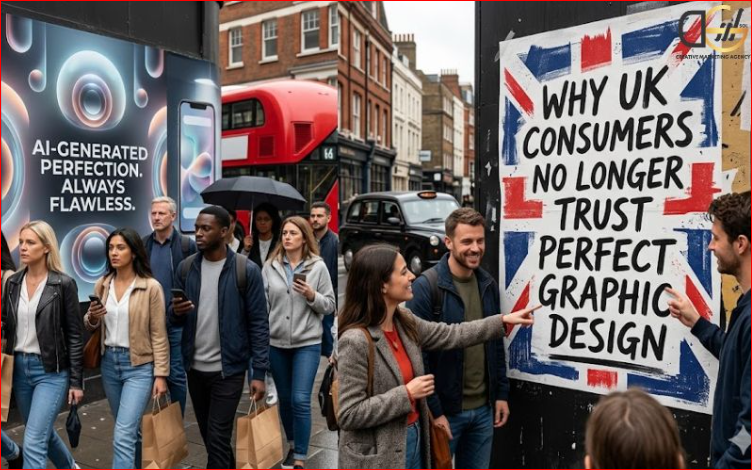
Something has changed in the way British consumers read design. Walk through any high street or scroll any UK brand’s Instagram feed, and you notice it immediately. The perfectly rendered, geometrically balanced, AI-assisted aesthetic is everywhere and, as a result, it no longer signals quality. It signals anonymity.
This shift is not just an aesthetic preference. It reflects a deeper psychological move. When everything looks equally polished, polish stops being a trust signal. UK audiences, who are among the most media-literate in the world, have grown fluent at scanning for signs of genuine effort behind a brand. They look for the things machines cannot easily fake: texture, personality, and a sense of human decision-making behind the visuals.
This is the central challenge facing UK brands right now. The tools that promised to raise design standards have simultaneously devalued the currency of polished design.
What Tactile Craft Design Means for UK Brands
Tactile craft refers to a design that carries the visible marks of human making. It draws from print culture, analogue processes, and physical materials. Think risograph-style layering, hand-lettered type, paper textures, visible grain, and deliberate irregularities that remind the viewer there is a person, not an algorithm, behind the work.
For UK brands, this approach carries particular resonance. British visual culture has always had an affinity for craft, from independent publishing to zine culture to the heritage design movements that still influence contemporary British identity. Tapping into that sensibility is not nostalgia. It is smart positioning.
What tactile craft design communicates to UK consumers:
- That the brand has invested creative thought, not just processing power
- That the visual identity has been made rather than generated
- That the company values distinctiveness over conformity
- That there is a considered human behind the output
Practically, this means briefs that ask designers to work with texture, hand processes, or analogue references. It means approving work with slight roughness rather than rejecting it in favour of cleaner renders.
The relationship between brand visual identity and long-term growth helps explain why professional graphic design matters for brand growth. It tells how design functions as a strategic business tool rather than a decorative layer.
The Candid Camera Roll Aesthetic and Why It Converts
Alongside tactile craft, another visual language is driving conversion trust in the UK right now: the candid camera roll aesthetic. This is photography that looks genuinely unposed, slightly off-centre, naturally lit, and captured in the moment rather than staged in a studio.
The reason this works is fairly straightforward. British consumers have grown up watching brands attempt to simulate authenticity through increasingly elaborate productions. They can tell. The micro-signals of a genuinely candid image, the slight motion blur, the imperfect framing, the real background, are things that cannot be easily faked at scale, and audiences know it.
| Design Style | Consumer Perception | Conversion Signal |
| AI-generated polished render | Generic, untrustworthy | Low |
| Studio-shot product photography | Professional but staged | Medium |
| Candid camera roll imagery | Real, human, trustworthy | High |
| Tactile craft and hand-drawn elements | Distinctive, effortful | High |
| User-generated content (UGC) | Peer-validated, authentic | Very High |
For product-led brands, this means allocating budget towards documentary-style photography that captures real use in real environments. For service brands, it means showing real people, real offices, and real work in progress rather than stock-library simulations of those things.
How AI Has Changed the Stakes for Design Authenticity

The irony of the current moment is that AI tools, which were supposed to democratise design quality, have created a new credibility problem for brands that rely on them too heavily. When every startup can generate a visually coherent brand identity in an afternoon, the identity itself carries less weight.
UK consumers, who are already sceptical of advertising by disposition, are developing increasingly sharp instincts for AI-generated content. The uncanny smoothness, the slightly off hands, the generic stock-beautiful faces, the weightless typography, all of these have become readable signals of a brand that has prioritised speed over substance.
This does not mean AI has no place in a UK brand’s design process. It means brands that use AI intelligently do so at the infrastructure layer, speeding up production while still directing the creative through human taste and genuine craft choices at the output level.
The brands suffering are those that have handed their entire visual identity over to generative tools and then distributed the results without human creative oversight. The output looks competent and says nothing, completely failing to build the graphic design trust UK consumers require. That is exactly the kind of design that UK audiences now scroll past.
Practical Design Choices That Build Consumer Trust in the UK
Making this shift does not require abandoning professional quality. It requires redefining what quality means in the current cultural context. The following approaches are proving effective for UK brands looking to rebuild visual credibility.
- Hand-rendered elements integrated into digital work
- The commission hand-lettered headline type rather than relying on geometric sans-serif.
- Use illustration styles that reference physical media: screen print, lino cut, watercolour.
- Incorporate physical objects photographed in natural light rather than rendered in 3D.
- Photography that prioritises reality over perfection
- Brief photographers on candid capture rather than posed arrangements.
- Accept images with natural shadows, real backgrounds, and human imperfections.
- Use real customers, employees, and environments over models and studios.
- Colour and texture choices that feel material
- Introduce paper stocks, linen textures, and analogue grain into digital design systems.
- Move away from pure RGB perfection towards the warmer, slightly imperfect palette of physical print.
- Allow design elements to overlap and interact with slight irregularity.
- Consistency through voice rather than perfection of execution
- Let visual consistency come from a recognisable brand personality rather than from rigid adherence to a template.
- Accept variation across touchpoints as a sign of human curation.
Brands measure whether these choices are effectively building the graphic design trust UK consumers expect through engagement and conversion signals rather than design awards.
Tracking social media campaign success changes user behaviour across channels, including social media performance.
The User Generated Content Connection
One of the clearest signals of where graphic design trust UK consumers place sits now is the performance of user-generated content against polished brand content. Across virtually every UK consumer category, content created by real customers outperforms content created by agencies.
The lesson here is not that brands should stop creating visual content. It is that brand content should take its visual cues from UGC rather than from traditional advertising production values. The goal is to look like something a person chose to share, not something a committee approved.
This has real implications for how UK brands brief their design teams and agencies. The brief can no longer be “make it look professional.” It has to be “make it look real.”
Practical Implementation Guide for Brands
Transitioning from a polished, AI-driven aesthetic to a tactile, human-centric approach requires careful execution. Brands must balance the need for raw authenticity with the essential requirements of user experience (UX) and functional digital navigation.
Step 1: Conduct a Visual Audit
Begin by auditing all existing marketing materials, including the website, social media assets, and digital advertisements. Identify areas where the design feels overly sanitised, algorithmic, or generic. Look for stock photography that lacks emotional depth, perfectly symmetrical layouts that feel sterile, and typography that lacks distinct character.
Step 2: Reintroduce the Human Element
Replace generic assets with bespoke, human-led content. This does not necessarily require a massive budget. A raw, unedited photograph taken on a smartphone by a staff member on the warehouse floor is often more effective at building trust than a heavily produced, AI-generated studio shot. Highlight the people behind the product, the manufacturing process, and the physical reality of the business.
Step 3: Embrace Textural Design
Work with UI/UX designers to introduce subtle tactile elements into the digital interface. Implement high-resolution textures in background elements to break up flat colour. Utilise custom typography for primary headings to establish a distinct brand voice. Ensure that these textural elements do not compromise the legibility or accessibility of the content.
Step 4: Utilise Strategic Asymmetry
Move away from rigid, strictly centred layouts. Experiment with asymmetrical compositions that guide the user’s eye through the content dynamically and engagingly. Allow elements to slightly overlap, use negative space aggressively, and create visual hierarchies that rely on contrast and scale rather than perfect alignment.
Step 5: Prioritise Honest Copywriting
Tactile graphic design must be supported by equally authentic copywriting. In the UK market, overly enthusiastic, marketing-heavy jargon will instantly undermine the trust built by raw aesthetics. Adopt a tone of voice that is straightforward, transparent, and respectful of the consumer’s intelligence. Combine ‘imperfect’ design with highly accurate, highly technical, and deeply informative content.
Step 6: Continuous A/B Testing
The shift to raw aesthetics should be an iterative process guided by data. Continuously A/B test different tactile elements against standard polished designs. Monitor key metrics such as engagement time, CTR, and final conversion rates. Because the UK market is diverse, the balance between raw authenticity and functional clarity will vary by industry and target demographic.
Partnering With The Best For Authentic Design
Navigating the shift from artificial perfection to raw, trustworthy aesthetics requires an agency partner that deeply understands the cultural nuances of the British market. As a full-service digital marketing agency based in Liverpool, DGSOL UK helps businesses move away from sterile, automated templates to build deeply credible, high-performing brand identities. By combining strategic human oversight with tactile craft, candid visual assets, and data-driven marketing strategies, DGSOL UK ensures your brand earns the elusive graphic design trust UK consumers demand, fueling long-term growth and measurable success.
Conclusion
The advent of artificial intelligence has undeniably revolutionised the execution of graphic design. However, it has also inadvertently destroyed the value of visual perfection, as evidenced by graphic design trust UK consumers’ response. In a digital environment where flawlessness is entirely commoditised, imperfection has become the ultimate premium asset.
For brands operating within the skeptical, highly sophisticated UK market, the implications are clear. Relying on cheap, polished, AI-generated design is a rapid route to brand devaluation and loss of consumer trust. The future of high-converting marketing lies in tactile craft and raw aesthetics. AI may have made polished design cheap, but genuine human authenticity remains priceless.
Ready to build a visual identity that actually earns trust with British consumers? Get in touch with DGSOL UK today.
FAQs
Why do UK consumers distrust overly polished graphic design?
Because AI tools have made polished design widely available and generic, British audiences now associate visual perfection with inauthenticity rather than quality.
What is tactile craft design, and how does it help UK brands?
Tactile craft uses handmade textures, analogue references, and deliberate imperfections to signal human effort and creative thought, thereby building stronger consumer credibility.
Is user-generated content more trusted than branded graphic design in the UK?
Yes, UGC consistently outperforms branded visuals in UK consumer categories because it carries peer validation and looks genuinely unmanufactured.
Can UK businesses still use AI in their design process?
AI works well at the production infrastructure level, but the creative direction and final output still need human oversight to avoid the generic quality that erodes trust.
What does DGSOL UK do to help brands with design and marketing?
It is a full-service digital marketing agency based in Liverpool that helps UK businesses build credible, high-performing brand identities and marketing strategies.
Does candid photography actually improve conversions?
Yes, candid, real-environment photography outperforms studio-staged imagery for conversion trust because it reads as genuine rather than manufactured for British audiences.